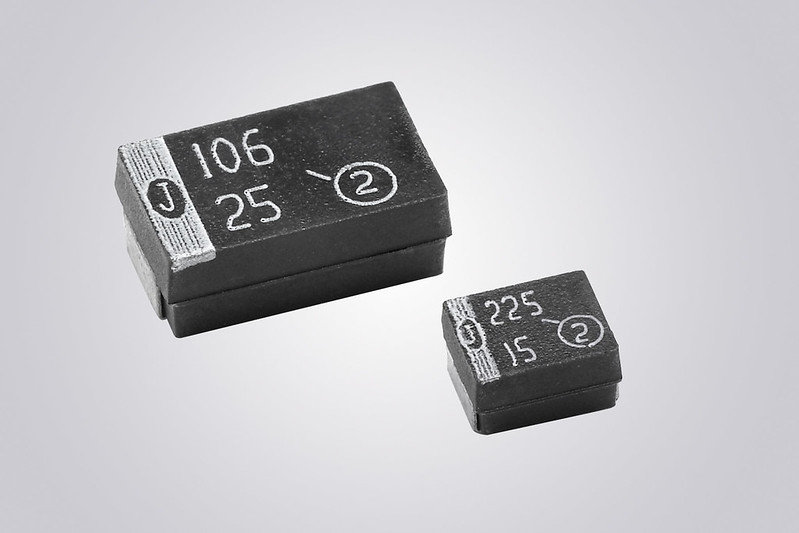









Capacitors are among the most widely used components in electronics, from simple LED circuits to industrial power systems. However, they come in a number of shapes and sizes and serve different purposes, but why do they differ so much, and does size really matter?
What is a capacitor?
A capacitor, along with resistors and inductors, belongs to a group of components known as passive devices. These components do not produce or amplify energy; instead, they can only store, absorb, or dissipate the energy that passes through them.
A capacitor is made up of two conductive plates – often metal foils or films – separated by a non-conductive material called a dielectric. The dielectric stops the plates from touching and allows an electric field to form between them when voltage is applied. Depending on how and where the capacitor is used, the dielectric can be made from materials such as air, glass, ceramic, or plastic.
Because capacitors can store energy, block direct current (DC), let alternating current (AC) pass, and filter unwanted signals, they are found in almost every type of electrical and electronic circuit.
What does a capacitor do?
A capacitor’s main job is to store and release electrical energy. This stored energy is known as capacitance. When needed, a capacitor can release its charge quickly, providing a short burst of power to a device. It also helps smooth out voltage changes by storing energy when voltage is high and releasing it when voltage drops, helping circuits run more reliably and maintaining stable operation.
When DC voltage is applied, electrons gather on one plate and are pushed away from the other, creating an electric field. Once the capacitor is fully charged to the same level as the DC supply, the current stops flowing because the dielectric prevents electrons from crossing between the plates.
With AC voltage, the voltage direction changes repeatedly. As a result, the capacitor charges and discharges continuously, allowing AC signals to pass through while blocking DC. This constant charging and discharging is a bit like filling and emptying a bucket – the level rises and falls as current flows in and out.
Why is the size of a capacitor important?
The size of a capacitor affects how much charge it can store (its capacitance), its voltage rating, and its physical dimensions, meaning that larger capacitors can store more charge, but take up more space and may handle higher voltages.
What do different-sized capacitors do?
The size of a capacitor influences its function, performance, and the space it occupies within a circuit. There are two broad categories of capacitors: fixed and variable.
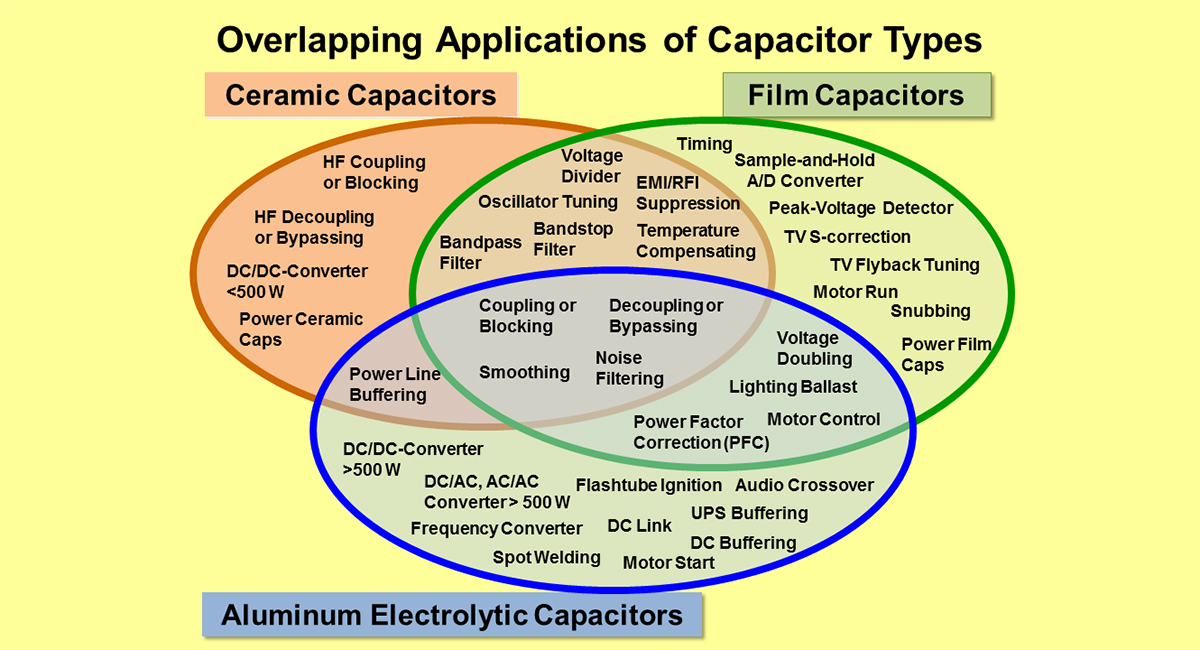
These categories are further divided based on the dielectric material used. Small capacitors, such as ceramic or film types, are used in high-frequency applications like signal processing, decoupling noise in microcontrollers, or stabilising power supplies. Larger capacitors, such as electrolytic or supercapacitors, are used in energy storage systems, power smoothing, or motor start circuits, where a higher energy capacity is needed.
Standard capacitors have a fixed value of capacitance, meaning they store and release a set amount of charge for a given voltage. They are widely used where stable, predictable behaviour is required, such as filtering or coupling signals.
Adjustable (or variable) capacitors, on the other hand, are often used in timing and tuning circuits, such as in radio receivers or oscillators. They allow precise adjustment of capacitance to fine-tune frequency or phase response within a circuit.
What happens if the wrong size capacitor is used?
Using the wrong capacitor can cause problems ranging from minor inefficiencies to circuit failure. A mismatch in capacitance or voltage rating can alter how current flows, affect timing, or even damage components.
If the capacitor is too small, it may not store enough charge to maintain a stable voltage, leading to signal noise, power dips, or poor filtering. In motor circuits, this could cause weak starting torque or excessive current draw.
If the capacitor is too large, it can take too long to charge or discharge, slowing circuit response times or overloading components at startup. In AC motor systems, an oversized capacitor can cause overcurrent or overheating, shortening component life.
But if the capacitor is the right size, it maintains circuit stability, smooths voltage, supports efficient energy transfer, and ensures components perform as intended – the ideal balance of energy storage and responsiveness.
As we have seen, capacitors are a simple but essential component that manage how electrical energy is stored, released, and controlled in a circuit. Their size and design determine how much charge they can hold, how quickly they respond, and how they influence overall circuit performance – making them key to everything from filtering noise in small devices to storing energy in large systems.