







iLabs Electronics’ Challenger+ RP2040 LoRa Mk II is a small development board based on the dual-core 133MHz RP2040 microcontroller and including an onboard RFM95W LoRa transceiver.
It has the Feather form factor (50.8 x 22.86mm) which allows it to be used in a breadboard, a 1.25mm JST li-po battery input connector, and USB-C power and program connection.
The Mk II revision introduces an upgraded power architecture that separates the MCU and RF power domains to minimise noise and enhance signal stability. It also adds a new ‘BConnect’ expansion interface supporting UART and I²C peripherals. With these improvements, the Challenger+ RP2040 LoRa Mk II offers a reliable platform for low-power IoT nodes and long-range wireless sensor network applications.
The Challenger+ RP2040 LoRa Mk II is based on the previous designs of iLabs, and it provides better functionality and more integration to support modern IoT applications. The RP2040 microcontroller together with the RFM95W LoRa transceiver gives it low power consumption along with efficient long-range communication, and is usable in battery-powered devices and remote data collection systems. Its small Feather form factor, USB-C, and Li-Po battery make the board easy to install in prototype and production systems to provide developers with a versatile and reliable platform to develop connected embedded systems.
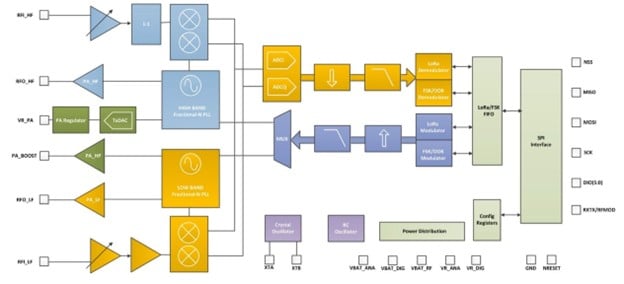
Challenger+ RP2040 LoRa MkII specifications
It is an embedded board based on the Raspberry Pi RP2040 microcontroller, with a 133MHz, two-core Arm Cortex-M0+ processor with 264KB of SRAM and 8MB of flash storage. The combination is sufficient in processing capabilities and storage to support sensor data capture, wireless communication, and embedded general operations. The board uses a Feather-standard form factor, 50.8 x 22.86mm, and has a USB-C programming, data transfer, and power input connector as well as a JST 1.25mm single-cell Li-Po battery connector.
In the case of wireless connectivity, it has an RFM95W LoRa module of Semtech based, which uses 868 or 915MHz, according to the regional setup. The transceiver has a maximum transmit power of +20 dBm and a minimum receive sensitivity of -148 dB which has a link budget of approximately 168 dB which is adequate to support long-range communication in IoT and remote monitoring systems. The antenna is connected with the help of U.FL (IPEX), and the SPI interface is used to connect the LoRa module with the RP2040 in order to transmit data swiftly and dependably.
The Mk II model introduces an improved power management design with isolated power domains for the MCU and RF sections, reducing noise and enhancing performance in sensitive wireless applications. It also features iLabs’ proprietary BConnect expansion interface, which exposes UART and I²C lines for easy peripheral integration. Additional I/O options include GPIO, SPI, I²C, UART, PWM, and four analog inputs, making the board highly versatile for embedded and IoT prototyping.
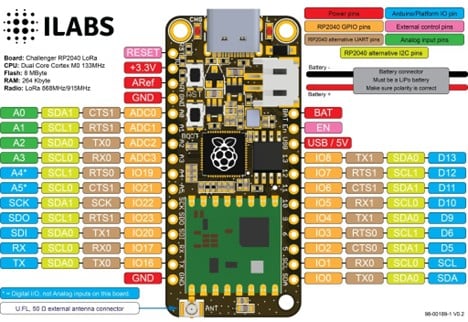
The board supports development within both the Arduino ecosystem, using Earle Philhower’s RP2040 core, and CircuitPython through Adafruit’s official distribution. This flexibility allows developers to choose their preferred programming environment for rapid prototyping and deployment. Creating LoRa-based applications is straightforward, as the onboard RFM95W transceiver communicates efficiently with the RP2040 via the SPI interface, while the accessible I/O pins make it easy to integrate external sensors and modules. Additionally, the built-in power management system intelligently switches between USB and Li-Po battery sources, ensuring consistent operation and reducing the need for additional external power circuitry. This thoughtful design simplifies hardware development and makes the Challenger+ RP2040 LoRa Mk II an excellent choice for compact, battery-powered IoT projects.
You can purchase the Challenger+ RP2040 LoRa Mk II directly from the iLabs website for $29.48. For detailed technical information and specifications, refer to the product’s datasheet page.
About the author:

Sayantan Nandy is an electronics content writer and engineer with over four years of industry experience. He’s worked with embedded systems, open-source hardware, and power electronics. His hands-on projects include work with ESP32, RISC-V chips, SoCs, and SBCs, along with designing power supplies, IGBT-based drives, and PCBs.