









When the Nobel Committee awarded this year’s Chemistry Prize for the development of metal–organic frameworks (MOFs), scientists at Vilnius University were not surprised. For Professor Mantas Šimėnas, a physicist at the university’s Faculty of Physics, the award was a long-anticipated recognition of a field that straddles the boundary between chemistry and physics.
Šimėnas, who has spent more than a decade studying MOFs, once co-authored a paper with one of this year’s laureates, Japanese chemist Professor Susumu Kitagawa. The two collaborated after meeting Kitagawa’s research team at a conference in Hawaii, where they agreed to explore how “guest” molecules in MOF structures affect magnetic properties. Their joint study, published in The Journal of Physical Chemistry, examined how molecules within MOF pores can alter a material’s magnetism — a finding that, Šimėnas recalled, was “immensely rewarding” early in his career.
MOFs are hybrid materials composed of metal centres linked by organic molecules, forming complex porous structures. Their tunable architecture has made them a cornerstone of research into gas capture, catalysis, and quantum devices. The Nobel Prize recognised Kitagawa, along with Omar Yaghi and Richard Robson, for pioneering the field.
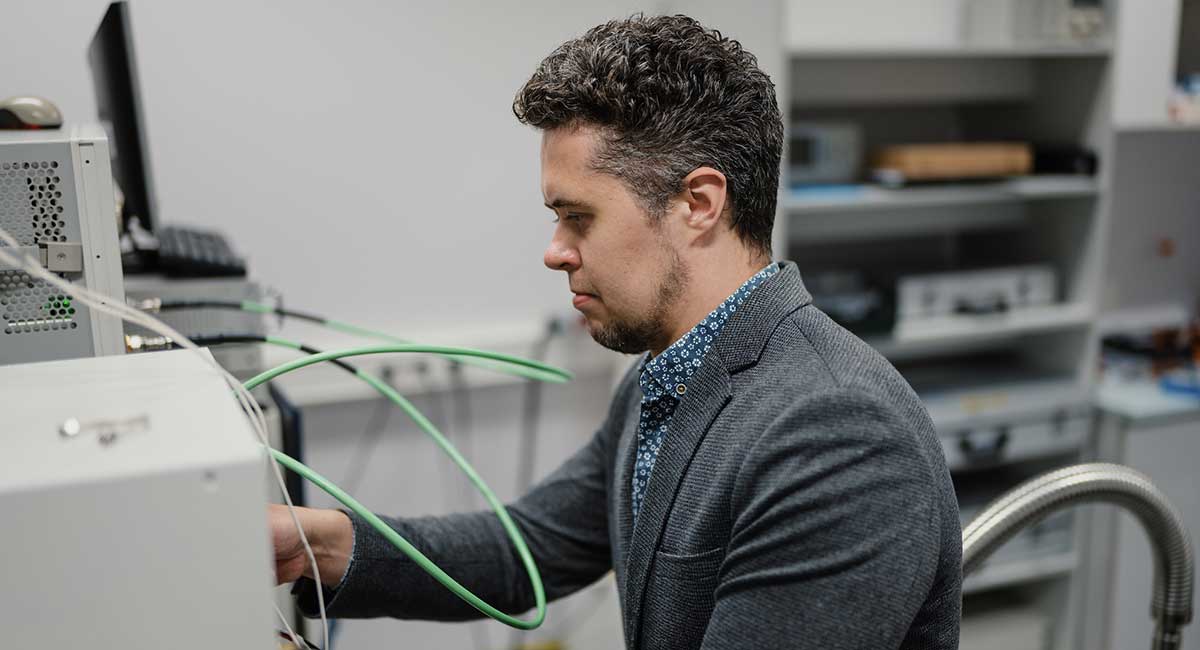
While chemists design and synthesise MOFs, Šimėnas and his colleagues focus on understanding their physical behaviour — how they respond to gases, temperature, and electric fields. Using electron paramagnetic resonance (EPR) and dielectric spectroscopy, the Vilnius team studies the microscopic and macroscopic dynamics within these materials.
“When gas molecules enter the pores, we can track how they bind to metal centres and how that changes magnetic properties,” said Šimėnas. “These reversible effects could make MOFs valuable for gas sensing applications.”
A €2.5 million European Research Council grant is now funding his efforts to improve EPR sensitivity, advancing the study of hybrid materials and quantum effects. His laboratory has become one of the most advanced in the Baltic region, with collaborations extending to Germany, the UK, the US, and Japan.
Šimėnas’ fascination with quantum behaviour dates back to his doctoral work, when he discovered an unexplained signal in an MOF spectrum. Years later, with the help of international experts, he identified the phenomenon as rotational tunnelling of methyl groups — a rare instance of quantum tunnelling at the molecular scale. The results, published in Science Advances, echoed the quantum tunnelling effects recognised by this year’s Nobel Prize in Physics.
Although his group’s attention has shifted towards hybrid perovskites — materials with potential for high-efficiency solar cells and LEDs — Šimėnas sees a common thread. “Both MOFs and perovskites reveal how hybrid materials can link chemistry and physics,” he said. “Chemistry creates, but physics explains.”