



A small aquatic insect with fan-like feet has inspired a new generation of agile, water-skimming robots capable of navigating turbulent conditions with remarkable precision.
Researchers from the University of California, Berkeley, Ajou University in South Korea, and the Georgia Institute of Technology have developed a robot, dubbed Rhagobot, that mimics the unique mechanics of Rhagovelia, a genus of water striders also known as ripple bugs. The findings were published in Science.
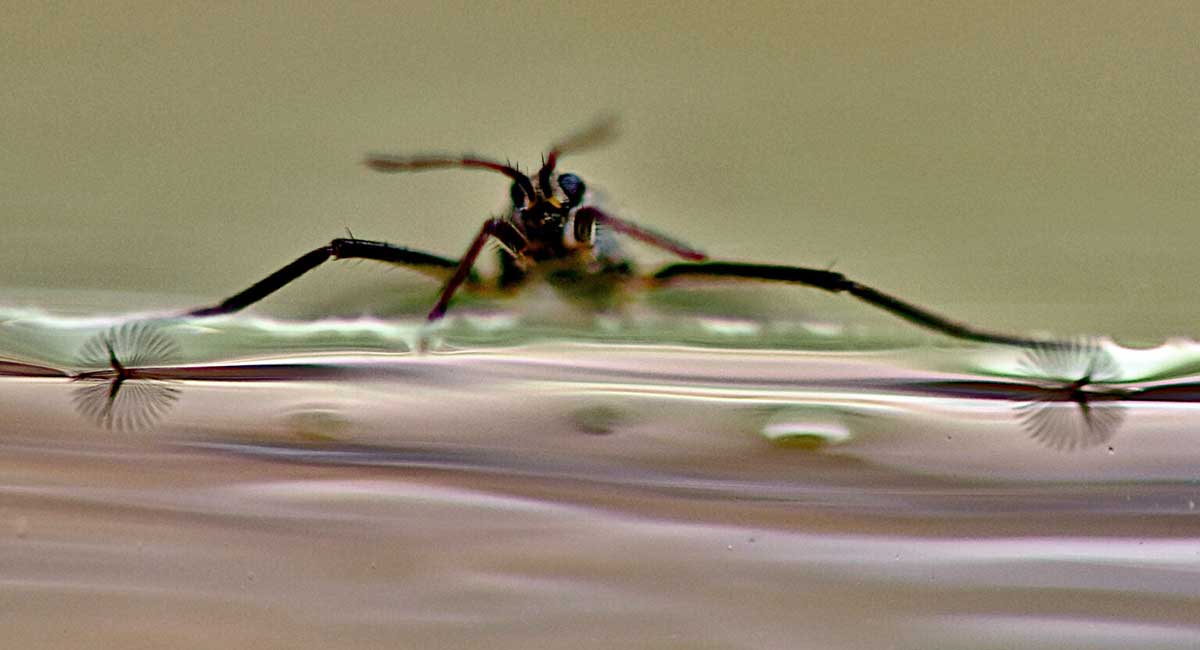
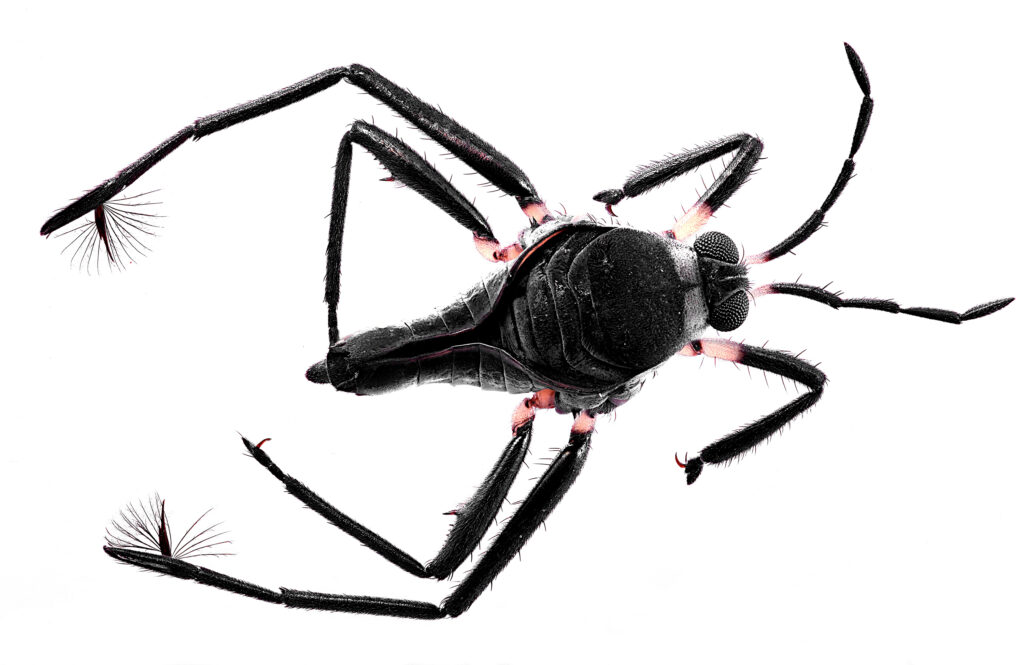
The team discovered that Rhagovelia’s feet unfold into fans when submerged, forming effective oars for gliding across the water’s surface. Remarkably, no muscles are needed to deploy these fans. Instead, surface tension – the cohesive force that allows the water’s surface to behave like a stretched elastic sheet – does the work. Once lifted from the water, the fans collapse, reducing drag and preparing the insect for its next stroke.
Victor Ortega-Jiménez, Assistant Professor of Integrative Biology at UC Berkeley and lead author of the study, said: “Observing for the first time an isolated fan passively expanding almost instantaneously upon contact with a water droplet was entirely unexpected.”
Inspired by this discovery, engineers at Ajou University created artificial versions of these fans and attached them to the legs of an insect-sized robot. The passive, self-spreading fans allowed Rhagobot to achieve stronger thrust, more controlled braking, and faster turning than previous water-skimming designs.
Such robots could be employed in environmental monitoring, search-and-rescue operations, or other applications requiring navigation on fast-moving or turbulent water.
Electron microscopy revealed that the natural fan is composed of flexible, ribbon-like strips equipped with barbules, resembling feathers. When expanded underwater, these become stiff enough to act as oars – a mechanism the researchers replicated in the robot’s design.
Je-sung Koh, Professor at Ajou University and senior author of the study, explained: “Our robotic fans self-morph using nothing but water surface forces and flexible geometry, just like their biological counterparts. It is a form of mechanical embedded intelligence refined by nature through millions of years of evolution. In small-scale robotics, these kinds of efficient and unique mechanisms would be a key enabling technology for overcoming limits in miniaturisation of conventional robots.”
Saad Bhamla, Professor at Georgia Tech and co-author, added: “We learned a rule from nature: the air-water surface can act as a battery. Surface tension powers the insect’s collapsible fan, and the same design powers the robot fan.”
The research showed that Rhagovelia can turn 90° in just 50 milliseconds – comparable to the rapid manoeuvres of flying insects like fruit flies – and travel at speeds of up to 120 body lengths per second.
Measuring only about 3mm long, Rhagovelia live in turbulent streams and coastal waters, where they must continually manoeuvre to evade predators and capture prey. Ortega-Jiménez noted: “They literally row day and night throughout their lifespan, only pausing to molt, mate, or feed.”
His interest in the insects began while studying larger water striders during his postdoctoral research.
“I was intrigued the first time I saw ripple bugs, while working as a postdoc at Kennesaw State University during the pandemic. These tiny insects were skimming and turning so rapidly across the surface of turbulent streams that they resembled flying insects. How do they do it? That question stayed with me and took more than five years of incredible collaborative work to answer it.”
After joining Georgia Tech, Ortega-Jiménez shared his findings with Bhamla, who encouraged collaboration with the Ajou University team. Together, they investigated the biomechanics of the insect’s fan and how to replicate it in a robot.
Postdoctoral researcher and co-lead author Dongjin Kim said: “We strongly suspected that biological fans might share a similar morphology, and eventually discovered that Rhagovelia’s fan indeed possessed a flat-ribbon microarchitecture, which had not been previously reported. This discovery further validated the design principle behind our artificial flat-ribbon fan.”
Rhagobot’s fans measure about 10 x 5mm and are mounted on the ends of two 5cm-long robotic legs. Weighing just 0.2g, the robot can travel at around two body lengths per second and turn 90° in less than half a second.
Ortega-Jiménez also found that Rhagovelia’s fan strokes create vortex patterns similar to those produced by flapping wings in air.
“It’s as if Rhagovelia have tiny wings attached to their legs, like the Greek god Hermes,” he said.
He is now exploring whether these fans generate lift in addition to thrust. The research team continues to study the insects, with live colonies maintained at UC Davis.
Sunny Kumar of Georgia Tech and Changhwan Kim of Ajou University also contributed to the study.