





In a pivotal step towards autonomous lunar exploration, Advanced Navigation has announced the successful completion of the critical terrestrial validation for its LUNA (Laser measurement Unit for Navigation Aid) sensor.
During a series of punishing, Moon-like trials on Earth, the LUNA sensor not only proved its core functionality but also exceeded the demanding performance requirements set by its commercial lunar surface delivery provider, Intuitive Machines, for its upcoming IM-4 mission, which includes NASA payloads. This achievement clears the path for LUNA to enter the final stage of space qualification.
“For decades, landing on the Moon has meant flying with only partial vision in the final kilometres,” said Chris Shaw, CEO and Co-founder of Advanced Navigation.
“With no GPS to guide them, landers depend on a combination of sensors that can introduce drift or deliver incomplete data – turning every descent into a high-stakes calculation where a single error could mean mission failure.”
“Our LUNA sensor aims to give lunar landers and rovers hyper-accurate ‘laser vision’ to see their own speed and position in the darkness of space, potentially making crashes a thing of the past and paving the way for safe, autonomous exploration. The technology delivers the predictability, reliability, and precision, missions need.”
The lunar South Pole is marked by deep, permanently shadowed craters that never receive direct sunlight, creating extreme darkness. Intuitive Machines’ IM-4 Nova-C class lander is scheduled to land there in 2027 under NASA’s Commercial Lunar Payload Services (CLPS) initiative, including Advanced Navigation’s LUNA sensor. Demonstrated performance has given the mission a high degree of confidence moving forward.
Solving navigational darkness on the moon
Landing on the moon remains a formidable challenge – there is no atmosphere or GPS, lighting is unpredictable, and the terrain is riddled with craters. To navigate these obstacles, spacecraft must possess extraordinary situational awareness and leverage advanced navigation technologies.
LUNA provides ‘laser light vision’ to eliminate this gamble. It uses laser beams to deliver a constant, live feed of the lander’s true 3D velocity and altitude relative to the lunar surface. This stream of precise data acts as a real-time correction, turning a high-stakes ‘partially blind’ descent into a controlled, accurate landing – a necessary step for enabling true autonomy on the Moon.
The sensor design defies conventional trade-offs, packing order-of-magnitude performance gains in a remarkably small and efficient form factor. Weighing just 2.8kg and approximately 8 times smaller in volume than alternative solutions, LUNA is designed for seamless integration into the Nova-C lander. Its performance replaces multiple legacy sensors, drastically reducing the overall mass, complexity, and cost of a mission. This consolidation represents a cost-saving of several million dollars for a typical lunar lander.
Animation of intuitive machines Nova-C Lunar lander autonomously landing with LUNA
Dr. Tim Crain, Chief Technology Officer, Intuitive Machines, said: “Advanced Navigation’s lightweight, high-performance sensor aligns with our strategy to reduce mass while increasing capability – and it complements our precision landing technology by adding critical velocity and altitude data during descent. This TRL9 maturity of these technologies represents a significant advance for the Australian space industry at large.”
Proven on Earth’s harshest terrains before conquering the moon
This pivotal validation was achieved through a rigorous testing campaign that pushed LUNA to its limits in the world’s most extreme, Moon-like environments, where traditional GPS and external signals are absent.
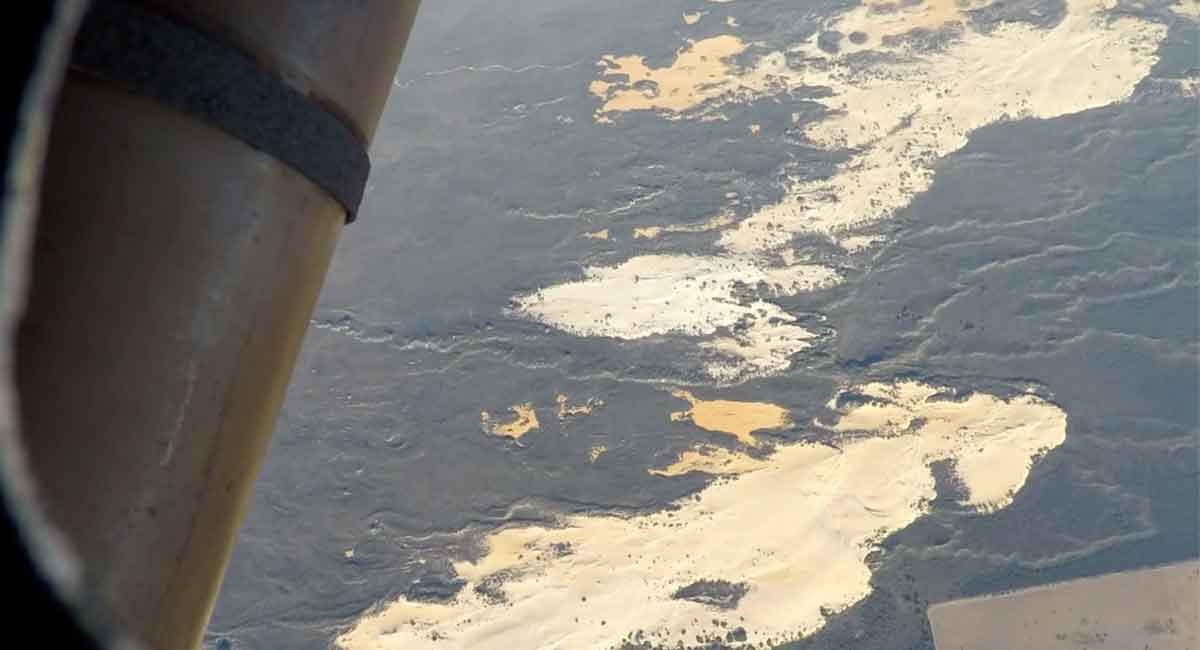
High above the desert: To simulate the high dynamics of the final 5km lunar descent, a LUNA sensor was flown on a light aircraft over the sandy terrain of Western Australia’s Pinnacles Desert, which served as a proxy for lunar regolith. In these GPS-denied flights, the system demonstrated a mere 28m of error after 100km of flight.
Deep below the ground: Trials were conducted in Europe’s deepest mine in Finland to simulate surface rover navigation. The harsh, dark, dusty, and GPS-denied conditions served as a direct analogue for a rover navigating shadowed Moon craters. Across a 6km stretch 400m below ground surface, LUNA achieved a best-case 3D position error of just 0.55m (0.009%) and an average error of 2.83m (0.047%). To put it into perspective, standard GPS typically delivers 2-10m of accuracy in open-sky conditions; LUNA surpassed this in an underground labyrinth.

The results demonstrate the navigation’s technology can achieve surgical precision in places where no external signals or prior information of the environment exist – an essential capability for lunar missions, where every centimetre counts.
LUNA enters final spaceflight qualification in preparation for IM-4 mission
Having surpassed Intuitive Machines’ technical requirements, LUNA is now entering the final stages of space qualification before being delivered for integration onto the spacecraft.
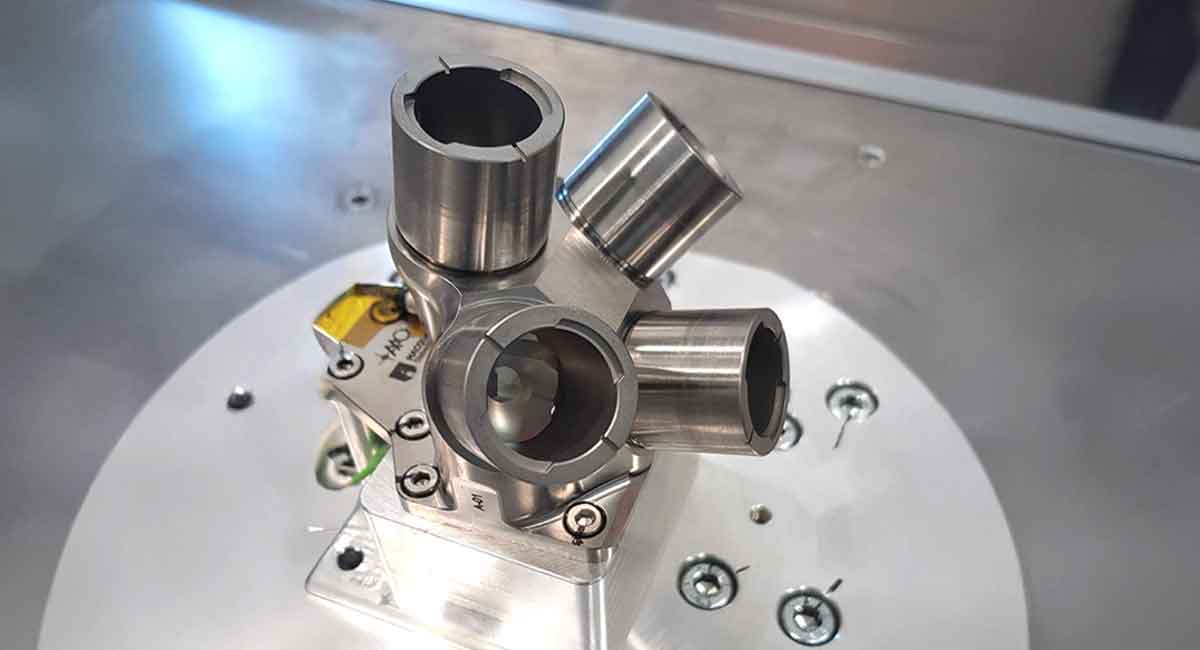
This milestone builds upon the rigorous design and testing already completed for LUNA’s core components. A major success was the full space qualification of the AAO LUNA Optical Head Assembly (ALOHA) – the system’s critical set of optical telescopes developed by Australian Astronomical Optics (AAO).
“We’ve battle-hardened our ALOHA system to survive the intense journey to the Moon,” said Lee Spitler, Head of Space Projects at Australian Astronomical Optics.
“Its four space-qualified telescopes deliver the laser beams that power the LUNA sensors’ ‘sight’, providing the critical velocity and range data the Nova-C lander needs to stick the landing.”
With foundational components such as ALOHA already proven, the complete LUNA sensor will now undergo its final integrated trials to certify it for flight, including:
- Shock and vibration testing to simulate the violent forces of a SpaceX Falcon 9 launch
- Electromagnetic compatibility (EMC) testing to military standards, verifying operation in space’s chaotic electromagnetic environment
- Thermal vacuum testing to ensure mission-ready performance in the searing heat and freezing darkness of space.
Unlocking the next phase of extreme exploration
LUNA is more than a landing sensor; it is a foundational technology that unlocks autonomous exploration in the most extreme, uncharted environments. By enabling precise navigation without any reliance on pre-existing infrastructure such as GPS, it paves the way for long-range rover traverses, robotic resource prospecting, and ultimately, the establishment of a sustainable human presence on the Moon and beyond.
Enrico Palermo, Head of the Australian Space Agency shares: “The LUNA sensor is a testament to the talent and innovation within the Australian space sector and paves the way for our nation to play an even greater role in the future of lunar exploration.”
This revolutionary capability extends beyond the Moon. Building on its rigorous testing campaign, a terrestrial version of LUNA – integrated with the company’s strategic-grade Boreas inertial navigation system (INS) – will be commercially available in late 2025. This Hybrid Navigation System is engineered to deliver the same performance for air and ground applications in GPS-denied environments on Earth.
Poised to redefine safety and efficiency across critical industries, LUNA’s terrestrial applications span from autonomous underground vehicles to low-altitude uncrewed aerial vehicles where precise, reliable navigation is crucial. Ultimately, the commercial LUNA sensor brings the same promise as its space counterpart: a continuous stream of precise motion data, unlocking a new era of autonomy for platforms operating in the world’s harshest conditions.