




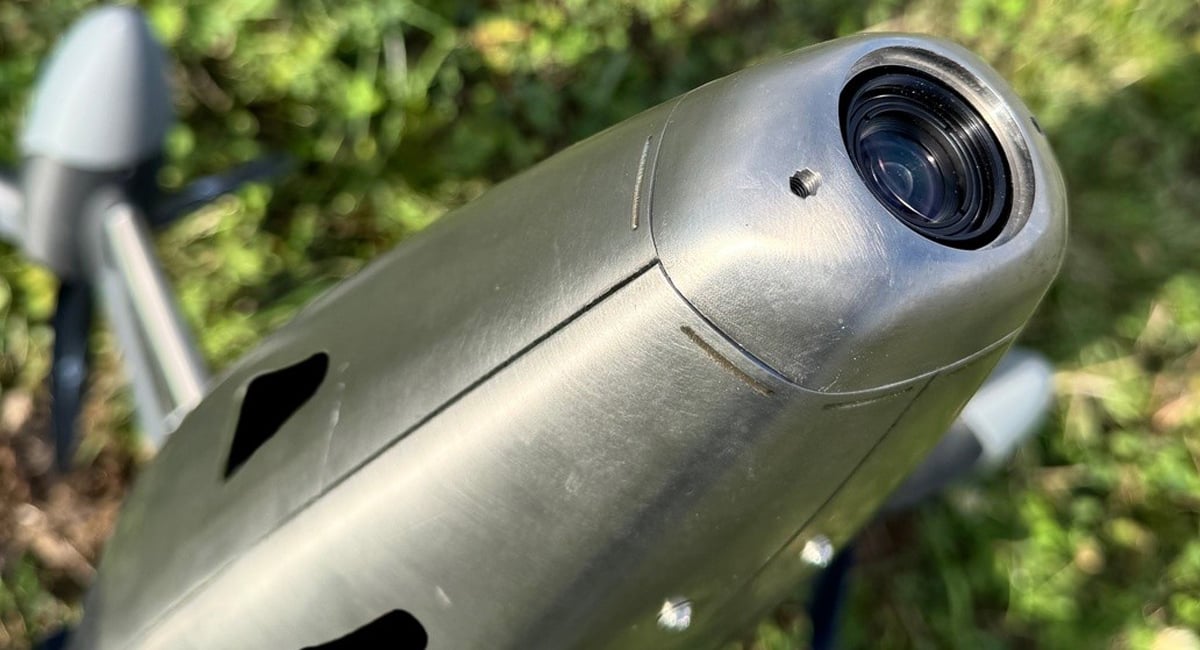
INTERCEPTOR MR (Medium-Range), integrated with MARSS‘ C4I NiDAR system and autonomously controlled using MARSS NiDAR EDGE software onboard, has successfully completed flight testing of its latest aircraft design, incorporating significant upgrades to its hardware and targeting algorithms during ongoing trials in the UK.
An AI-enabled, cost-effective, and low-collateral alternative to short-range missiles, INTERCEPTOR-MR is capable of engaging drones at ranges in excess of 5km. Unlike conventional kinetic options, the system uses no explosives or fuel, ultimately making it safer to deploy in both military and civil environments.
INTERCEPTOR-MR is also recoverable and redeployable as standard when used against some smaller drones – either by returning to base, or by deploying a parachute for collection.
Having reached fully autonomous flight status in early 2024, large-scale upgrades and enhancements to INTERCEPTOR’s targeting algorithms, which use the proprietary hybrid-intelligence deployed on MARSS’s NiDAR platform, have fuelled a significant step forward in system maturity and targeting accuracy.
These developments have sparked widespread interest in the platform among both existing and prospective customers worldwide. Building on this momentum, the system has been down-selected for evaluation by a NATO member country in the coming months.
In parallel, MARSS is working directly with several existing customers to tailor INTERCEPTOR-MR to their operational environments and specific challenges, with discussions focused on pushing the performance envelope to protect critical infrastructure and national assets against rapidly evolving threats.
“This is a really exciting time in the evolution of our INTERCEPTOR-MR. As drone warfare continues to advance at pace, soft-kill activities, such as jamming, are becoming increasingly less effective, particularly against fibre-optic guided threats. The ability of INTERCEPTOR to provide a safe and cost-effective hard-kill solution against a range of targets, from FPVs to Shaheeds, is more relevant than ever,” said Stephen Scott, Managing Director of MARSS Defence Labs.
The interest in MARSS’s INTERCEPTOR-MR has resulted in heavy investment in the personnel behind the platform to ensure that future opportunities can be fulfilled. In the last few months alone, the UK team’s workforce has grown by 50%, and MARSS continues to recruit with a view to that number doubling once again within the next six months.
This is in preparation for the company to commence full production of the system, which is expected to start in 2026.
The system’s hardware has been designed from the outset to allow for third-party manufacture in customer nations. However, with INTERCEPTOR-MR having strong roots in the UK – the current system having been designed and built entirely within MARSS’s Bristol-based research and development facility – the country will remain a key hub for design, development, and potential production, particularly for European markets.
“We’re receiving fantastic feedback and interest from our existing customers, with several looking at deploying the platform, alongside the NiDAR system that they are currently using, in the near future,” added Scott. “The potential applications of this product have a truly global footprint; we’re currently in talks with both current and potential customers from the Middle East, Asia Pacific, North America, and a number of NATO states. Several regions are already seeking evaluation quantities of the INTERCEPTOR, with the aim of future procurement in 2026.”
Key stakeholders from across MARSS will be on hand to discuss the unique capabilities of INTERCEPTOR-MR and MARSS’s NiDAR platform in the Tech Zone during DSEI UK 2025, from 9-12 September.