





Researchers from The Grainger College of Engineering at the University of Illinois Urbana-Champaign have found a new way to improve current laser design – by levelling up photonic-crystal surface-emitting lasers (PCSELs).
PCSELs are fabricated using air holes. However, the team has shown that PCSELs can actually work with their air holes replaced by a solid dielectric material. This is important because air holes, while great for directing light, can lose their shape when the semiconductor material is heated and grown back over them – a process called regrowth. By using a stable solid instead, the team were able to keep the crystal structure intact, which helps the laser keep performing well over time. Not only this, they’ve also managed to get this new design to lase at room temperature, at an eye-safe wavelength, without the cooling that’s usually needed for experimental devices – demonstrating that it could work in practical applications.
What are photonic crystals?
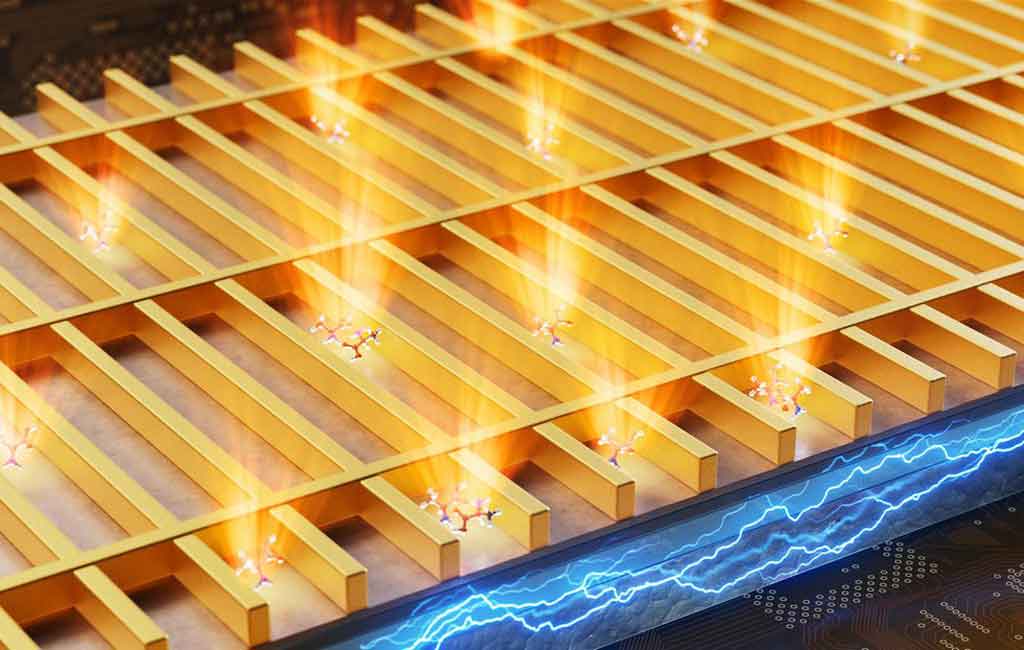
Photonic crystals are made from alternating layers of refractive structures arranged in a repeating pattern, which can reflect, block, or guide certain wavelengths, much like a crystal lattice controls electrons in a solid. Change the scale, and you change the type of light they interact with – for example, micron-sized patterns work with optical light, while centimetre-sized patterns work with microwaves.
What are PCSELs?
Photonic-crystal surface-emitting lasers (PCSELs) are semiconductor lasers that use a photonic crystal layer to shape and direct their light. The result is a beam that is bright, narrow, and round, and stays that way even as you scale up the output power – something that’s hard to achieve with more traditional laser designs.
The problem with air holes
Most PCSELs use tiny air holes in their photonic crystal layer. The large difference in refractive index (a measure of how much light bends when passing from one medium to another) between air and the surrounding semiconductor makes these holes excellent for controlling how light bounces around inside the device. The downside is that air holes are fragile in fabrication terms, and with any kind of device you want to reduce losses.
During regrowth, the semiconductor surface is heated – often to several hundred degrees Celsius – so atoms can attach to it and grow new layers. At those temperatures, some of the existing atoms on the surface can move around in a process called mass transport, which can cause the sharp edges of the air holes to blur or fill in. In some cases, perfectly round holes can turn into ovals or rectangles. This matters because the precise shape and size of the holes directly affect the laser’s beam quality and efficiency. In materials like indium phosphide (InP), which is used for eye-safe wavelengths, this distortion is even more likely, making high-power, high-quality PCSELs harder to achieve.
To get around this, the Illinois team explored replacing the air holes with a material that could survive regrowth without changing shape.
A buried dielectric solution
The Illinois team replaced the air with a solid, low-index dielectric – silicon dioxide (SiO₂) – patterned into the photonic crystal layer. This material stays stable at the high temperatures needed for regrowth, so the pattern doesn’t change shape. Using a process called lateral epitaxial overgrowth, the team were able to grow the semiconductor around and over the SiO₂ features, sealing them inside the laser structure while keeping the surrounding material a perfect single crystal.
The trade-off is that silicon dioxide doesn’t have quite as large a refractive index difference from the semiconductor as air does, so the light control is slightly weaker. But in return, the device gains stability, better thermal handling, and potentially longer life under demanding conditions.
Why it matters
By proving this new PCSEL design works at room temperature – without special cooling – and at an eye-safe wavelength, the researchers have shown that this approach could open the door to reliable, high-quality PCSELs for applications like LiDAR in autonomous vehicles, precision laser cutting and welding, and free-space optical communication.