
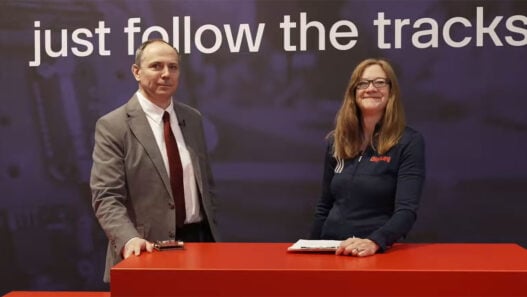


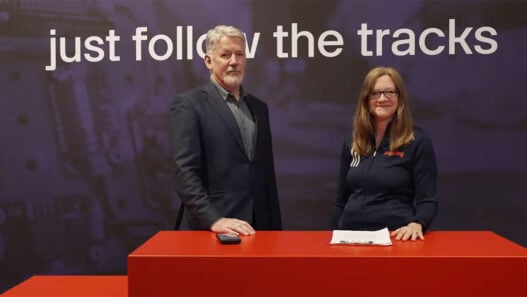
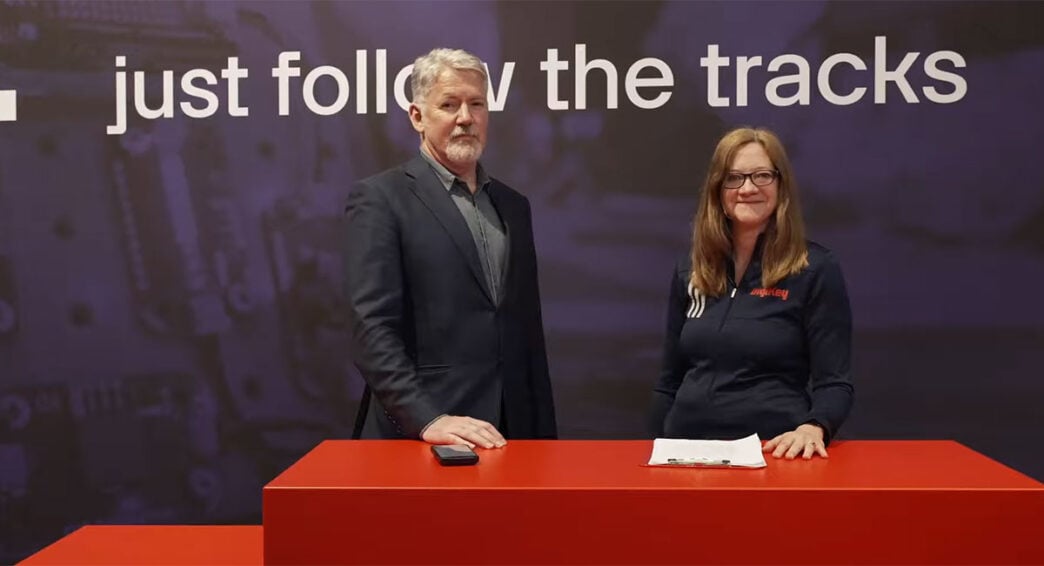
At embedded world 2026 on the DigiKey booth, Lucy Barnard spoke with Mike Fitton, Vice President and General Manager at Altera, about NPIs, overall business updates, industry trends, and more.
Altera provides leadership programmable solutions that can be deployed in applications from the Cloud to the Edge. Its end-to-end portfolio of products includes FPGAs, CPLDs, Intellectual Property, development tools, System on Modules, SmartNICs, and IPUs to provide flexibility.
Altera has entered a new phase in its company journey following its separation from Intel roughly six months ago.
Fitton explained that the transition marked a strategic shift, allowing the company to focus more directly on the global FPGA market and expand its portfolio of programmable logic solutions.
“Operational independence really means for us to double down on focusing on the broader FPGA market,” he said. “It’s super exciting walking around the halls here seeing all of the applications where programmable logic is fundamental to what our customers are doing.”
Altera originally joined Intel in 2016, a move that Fitton said delivered substantial technology investment over the following decade. That period enabled the company to advance its FPGA development using both Intel’s manufacturing capabilities and external foundries.
While acknowledging that support, Fitton suggested that independence created opportunities for greater agility in product development and market strategy.
“Being separate enables us to be agile and really invest from an FPGA portfolio perspective,” he said.
A central part of that portfolio is the company’s Agilex family of devices, which spans high-performance and cost-optimised segments. Fitton highlighted the Agilex 7 series at the high end of the market, alongside the Agilex 5 and Agilex 3 devices targeting mid-range and power-sensitive applications.
According to Fitton, the aim is to support a broad spectrum of deployment models, from discrete FPGA devices in small-form-factor systems to integrated solutions working alongside CPUs and GPUs.
The discussion also touched on wider shifts in embedded systems design. Fitton identified three trends currently driving redesign cycles across the industry.
The first involved the convergence of IT and operational technology, particularly in robotics and safety-critical environments. As industrial systems incorporated more connected and intelligent capabilities, programmable hardware played a role in handling deterministic processing requirements.
Security represented the second driver. Fitton pointed to the European Cyber Resilience Act as a regulatory framework influencing product design globally, noting that the legislation applied to any company selling technology into Europe.
The third trend centred on AI. While AI infrastructure in data centres continued to expand, Fitton emphasised the growing importance of AI inference at the Edge, where latency and power constraints shaped system architecture.
Fitton argued that one of the defining advantages of FPGAs remained their reprogrammability. Unlike fixed-function hardware such as ASICs, programmable devices could adapt as algorithms evolved or as security standards changed.
That flexibility also extended to AI workloads. Instead of relying solely on dedicated AI accelerators, Altera incorporated tensor processing capabilities directly within the FPGA fabric, enabling engineers to reconfigure hardware pipelines as neural network architectures developed.
Fitton illustrated the company’s role in the AI ecosystem using an analogy drawn from the California gold rush.
“A lot of people made money in the gold rush, but mostly it wasn’t people looking for gold, it was people selling shovels,” he said. “It’s a little bit prosaic to say it, but we’re selling shovels when it comes to the AI boom.”
Find out more in the interview below.